With the popularization of health preservation concepts, saunas have gradually become an important choice for home health equipment. A number of authoritative studies have confirmed that regular sauna use offers significant health benefits:
A team from the University of Eastern Finland conducted a 21-year follow-up study on 2,315 men aged 42-60 (published in JAMA). The study found that those who used saunas 4-7 times a week had a significantly lower mortality rate than those who used them once a week; moreover, individuals who spent more than 19 minutes per sauna session had a 53% lower mortality rate than those who spent less than 11 minutes.
Another 15-year follow-up study on 1,688 Finnish residents aged 53-73 (approximately 50% male and 50% female) verified that people who used saunas 4-7 times a week had a 70% lower risk of dying from cardiovascular disease compared to those who used them once a week. This conclusion applies to both men and women.
A 20-year follow-up survey of more than 2,000 middle-aged men also found that those who used saunas 4-7 times a week had a 66% lower risk of developing dementia and a 65% lower risk of Alzheimer's disease. Meanwhile, their risks of sudden cardiac death and coronary heart disease-related death also decreased significantly.
However, the two mainstream types of saunas on the market—"steam sauna" and "far-infrared sauna"—often leave consumers confused when making a choice. Although both fall under the category of thermotherapy, they differ significantly in terms of working principle, user experience, health benefits, and installation and usage characteristics. This article systematically analyzes the core differences between the two and provides a scientific selection basis based on the latest research results.
I. Core Difference 1: Comparison of Working Principles
The fundamental difference between the two saunas lies in their heat transfer methods, which directly determine subsequent user experience and functional effects:
-
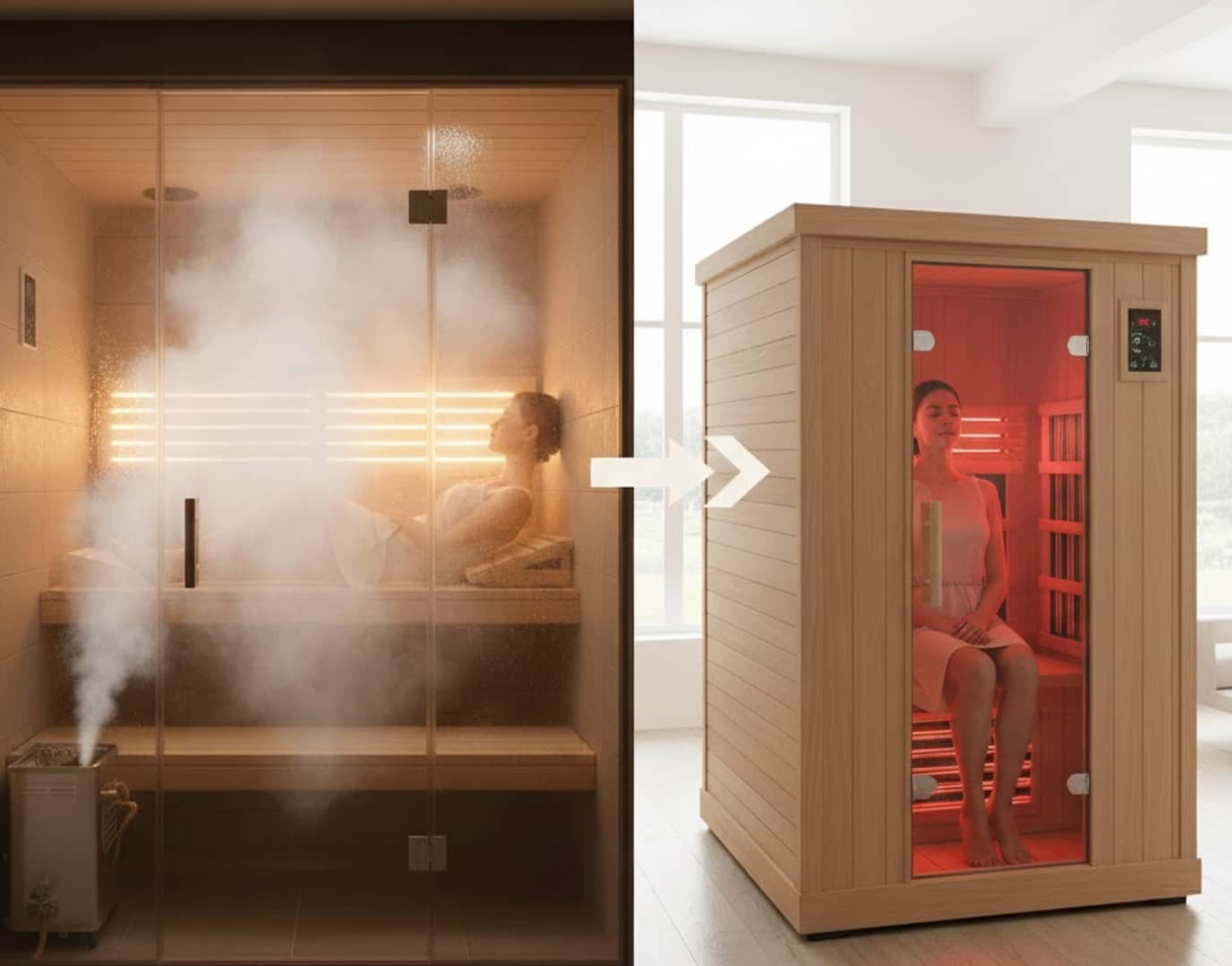
Steam Sauna (Wet Sauna): It uses electric heating elements to boil water and generate high-temperature steam, creating a humid and hot environment in a sealed space. The temperature is usually controlled at 40-55°C, with a relative humidity of up to 80%-100%. Heat acts on the human body through "air conduction + sweat evaporation," achieving a passive heating mode where "environmental heating drives body heating."
-
Far-Infrared Sauna (Dry Sauna): It emits 8-14μm far-infrared rays (with a frequency close to that of the human body's far-infrared spectrum) through carbon fiber, ceramic tubes, or graphene heating films (which heat up quickly, reaching the set temperature in 30 seconds; temperature uniformity is ±2°C; electrothermal conversion efficiency exceeds 95%; service life is over 100,000 hours). These rays can penetrate 3-5 cm into the skin and act directly on subcutaneous tissues, realizing an active heating mode where "the body heats up actively rather than being heated by the environment." The ambient temperature is generally 38-60°C, with a relative humidity of only 30%-50%.
Core Summary: Steam saunas transfer heat through a humid and hot environment, while far-infrared saunas act directly on subcutaneous tissues via far-infrared rays. This is the root cause of the functional differences between the two.
II. Core Difference 2: Comparison of User Experience
Different combinations of temperature and humidity result in distinct sensory experiences for the two saunas. The specific differences are as follows:
|
Experience Dimension
|
Steam Sauna (Wet Sauna)
|
Far-Infrared Sauna (Dry Sauna)
|
|
Temperature Sensation
|
40-55°C, strong sense of humid heat enveloping the body, obvious warmth on the skin surface
|
38-60°C, dry heat without skin-burning sensation, prominent warmth inside the body
|
|
Humidity Sensation
|
High-humidity environment with visible steam, moist feeling when breathing, easy fogging on glasses
|
Low-humidity environment with dry air, no oppressive feeling when breathing, no fogging on glasses
|
|
Sweating Status
|
Sweats quickly, large amount of sticky sweat, requiring timely hydration
|
Sweats gently, low stickiness of sweat, slight sticky feeling on the body
|
|
Tolerable Duration
|
Most people can tolerate 10-15 minutes, prone to a stuffy feeling
|
Most people can tolerate 20-30 minutes, less likely to feel fatigued
|
User feedback shows that steam saunas induce rapid sweating upon entry, with a strong sense of humid heat; far-infrared saunas deliver gradual warmth that penetrates the body, and it is not easy to feel stuffy even when sitting still. This is because high humidity reduces the efficiency of water evaporation from the respiratory mucosa, while far-infrared rays heat the body through resonance with human cells, avoiding discomfort caused by a sudden rise in surface temperature.
III. Core Difference 3: Comparison of Health Benefits
Based on different heat transfer principles, the two saunas have distinct focuses in terms of health benefits, both supported by authoritative research:
(1) Core Health Advantages of Steam Sauna
-
Respiratory Tract Care: Warm steam can moisten the respiratory mucosa, relieve dryness and nasal congestion, and is particularly suitable for dry autumn and winter seasons or people with rhinitis. Studies show that regular use of steam saunas reduces the risk of pneumonia by 27%, and for those who use them more than 4 times a week, the risk decreases by 42% (data from People's Daily Online).
-
Cardiovascular Protection: It rapidly increases the surface temperature in a short time, promoting blood vessel dilation and increasing blood circulation speed by 30%-50% (equivalent to the effect of 30 minutes of brisk walking). A study by the University of Eastern Finland confirmed that using a steam sauna 2-3 times a week can reduce the risk of hypertension by 24%, while using it 4-7 times a week can reduce the risk of cardiovascular disease mortality by 70%.
-
Skin Cleansing: A large amount of sweat can remove dirt from pores, and the steam softens the cuticle, improving skin smoothness by 20%-30%. It is particularly suitable for people with oily skin.
(2) Core Health Advantages of Far-Infrared Sauna
-
Deep Thermotherapy and Pain Relief: The 6-14μm far-infrared rays resonate with the human body's spectrum, and the heat can penetrate 5 cm into the subcutaneous tissue, which is 35% more effective in relieving muscle soreness than traditional steam saunas. A study published in the Journal of Psychotherapy and Psychosomatics showed that after using a far-infrared sauna daily for 14 days, patients with chronic pain achieved a 77% pain relief rate; moreover, combining 15 minutes of far-infrared sauna use after exercise can further reduce the risk of fatal cardiovascular events (more effective than exercise alone).
-
Metabolism Boost and Calorie Consumption: The internal-to-external heating mode promotes metabolism. The calorie consumption in the same usage time is 15%-20% higher than that of steam saunas, consuming approximately 180-220 kcal per 30 minutes (equivalent to light jogging).
-
Gentle Health Preservation and Blood Pressure Control: The low-humidity environment exerts less pressure on the cardiovascular system, reducing systolic blood pressure by an average of 5-8 mmHg. For patients with hypertension (non-severe type), using it under the guidance of a doctor is safer than using a steam sauna; at the same time, regular use can help reduce the risk of dementia (similar to the mechanism of steam saunas, both achieved by improving circulation and neuroprotection).
Important Tips from Medical Experts
-
Basic Principles: Regardless of the type of sauna chosen, "hydration + moderation" must be followed—drink 300-500 ml of warm water (preferably with electrolytes) before and after each use, avoid using it on an empty or full stomach, and the optimal effect is achieved by using it 2-3 times a week for 15-25 minutes each time.
-
Contraindicated Groups: Pregnant women, patients with acute illnesses, and patients with severe hypertension (systolic blood pressure > 180 mmHg) are prohibited from using saunas; diabetic patients should carry candy with them when using saunas to avoid hypoglycemia; for people over 60 years old, the initial usage time is recommended to be controlled within 10 minutes.
-
Precautions: Saunas can relieve muscle soreness, but their impact on core body temperature is less than that of hot water baths, and they cannot replace regular exercise. Studies have shown that the combination of "high aerobic fitness + high-frequency sauna use" can reduce the risk of sudden cardiac death by 69% (more significant than using saunas alone or exercising alone).
IV. Core Difference 4: Comparison of Installation and Usage Characteristics
From the perspective of home application, installation conditions and usage costs are key considerations. The specific comparisons are as follows:
-
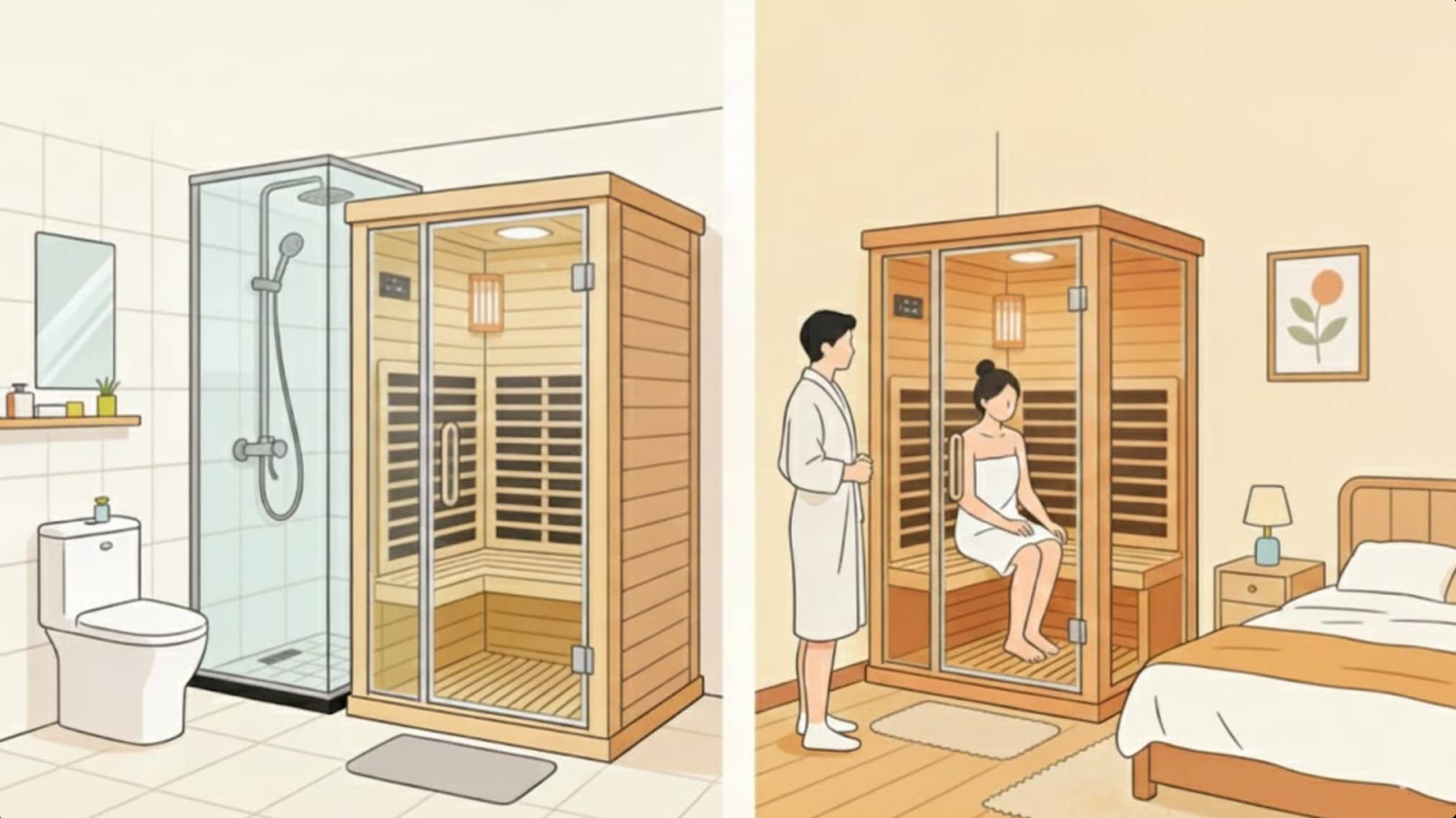
Installation Space: Steam saunas require reserved water supply and drainage pipes and have high requirements for space airtightness (suitable for bathroom renovation or dedicated areas); far-infrared saunas do not require water supply and drainage, only a power source. Small single-person models occupy only 0.5-1㎡ of space and can be flexibly placed in bedrooms or balconies.
-
Power Consumption: The power of steam saunas is usually 2-3 kW per hour; the power of far-infrared saunas is 1-1.5 kW per hour, making them more energy-efficient for long-term use.
-
Maintenance Cost: Steam saunas require monthly cleaning of heating tube scale with a 1:100 diluted citric acid solution, and heating tubes need to be replaced every 2-3 years (costing 300-500 yuan); the service life of graphene heating films in far-infrared saunas is over 100,000 hours, and the service life of carbon fiber heating elements is approximately 50,000 hours. The long-term maintenance cost is only 1/5 of that of steam saunas.
V. Scientific Selection Guide: Demand-Based Decision Reference
Based on the above differences, consumers can make accurate choices according to their own needs:
Scenarios for Prioritizing Steam Sauna
-
Need for rapid sweating and deep skin cleansing, with an independent bathroom space at home;
-
Usage in commercial venues (bath centers, beauty salons) to replicate the traditional humid and hot sauna experience;
-
Usage in autumn and winter to relieve respiratory dryness and discomfort.
Scenarios for Prioritizing Far-Infrared Sauna
-
Emphasis on gentle health preservation and relief of muscle soreness (e.g., post-exercise recovery), or dislike of stuffy and high-humidity environments;
-
Limited installation space (e.g., small apartments) or no conditions for water supply and drainage renovation;
-
Shared family use (including the elderly and children), requiring low maintenance, energy efficiency, and higher safety.
Advanced Suggestion
The two types of saunas are not mutually exclusive and can be used in combination according to seasons—use far-infrared saunas in summer (dry and non-stuffy, avoiding the superposition of humid heat); use steam saunas in winter (warm and moisturizing). Families with conditions can adopt a "partial renovation + flexible supplementation" plan: install a steam sauna module in the bathroom and place a small far-infrared sauna in the bedroom/balcony to maximize coverage of health needs.
References
-
University of Eastern Finland, 21-year follow-up study on 2,315 men (sauna, mortality, and heart disease risk), JAMA: http://m.ningxialong.com/c/091324032202025.html
-
University of Eastern Finland, 15-year follow-up study on 1,688 men and women (sauna and cardiovascular disease mortality risk), People's Daily Online: http://m.toutiao.com/group/6633268014189904392/?upstream_biz=doubao
-
University of Eastern Finland, 20-year follow-up study on more than 2,000 middle-aged men (sauna and dementia risk), People's Daily Online - Life Times: http://health.people.com.cn/n1/2017/0102/c14739-28992748.html